Digital artefacts
A workshop that ends in a photograph has produced a souvenir. The output of story mapping and example mapping has to leave the room as a file the tool chain can read without a human in between — or the agreement reached that afternoon starts decaying the moment everyone stands up.
This is the step where connected stops being an adjective. Two specialists who agree in a room and then write their agreement down twice, in two formats, have not been connected — they have been synchronised once, and are now drifting.
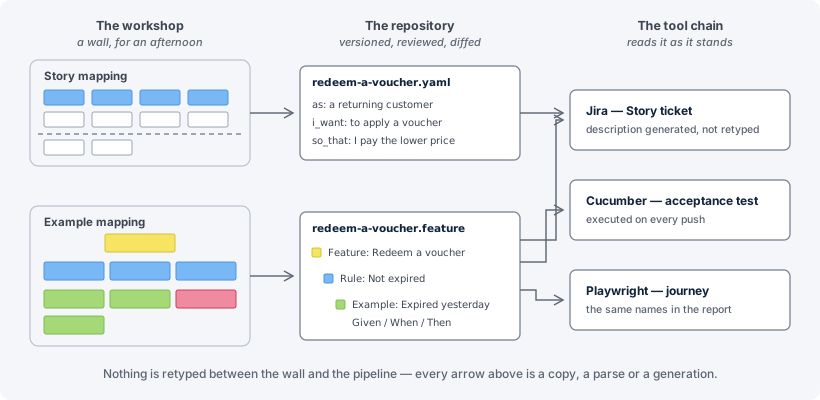
The wall is where the agreement is reached; the file is what the agreement becomes. Every arrow is a copy, a parse or a generation — never a person reading one artefact and typing another.
The two artefacts
Section titled “The two artefacts”| Workshop | Emits | In | Read by |
|---|---|---|---|
| Story mapping | The backbone, the slices, and one story per cell | A story DSL — As a … I want … so that … |
The tracker, the team, whoever asks why |
| Example mapping | Rules, examples, open questions | Gherkin — Feature / Rule / Example |
Cucumber, Playwright, the tracker |
They are not equally standardised, and pretending otherwise would set a team up for disappointment. Gherkin is a real standard with real parsers: the file you write is the file Cucumber executes, in every language this hub covers. The story DSL is a convention you adopt — the sentence is universal, the file format is yours. That asymmetry decides how much to invest in each, and it is the first thing on this page worth remembering.
What story mapping emits
Section titled “What story mapping emits”One file per cell of the map, holding the story in the DSL everybody already recognises, plus the coordinates that a flat backlog throws away:
id: CHK-014activity: Pay                 # position on the backboneslice: release-1              # which horizontal cut it belongs to
story:  as: a returning customer  i_want: to apply a voucher code at checkout  so_that: I pay the lower price I was promised
scenarios: features/checkout/redeem-a-voucher.featurequestions: []                 # red cards; a non-empty list blocks emission
Four things are being kept here that a ticket alone loses:
The so_that clause. It carries the why, it is the first thing dropped
when a story is retyped, and it is the only part that can answer “should we still
build this?” six months later. A story whose so_that reads “so that the feature
is complete” has no benefit and is a task with a story’s grammar.
The position on the map. activity and slice are what let the map be
rebuilt from the repository rather than redrawn from memory. A backlog that has
lost them is the flat list story mapping existed
to prevent.
The link to the scenarios. One field, and the story stops being a summary of its own acceptance criteria and becomes a pointer to the executable ones.
Readiness, as data. questions is the red cards from
example mapping. Non-empty means the story is
not ready, and that is now a condition a script can check rather than a judgement
someone makes under sprint-planning pressure.
A caution worth stating: as: a user for every story is the classic smell. If
every role is “a user”, no role was ever identified, and the sentence has become
a template being filled in rather than a decision being recorded.
What example mapping emits
Section titled “What example mapping emits”Here the mapping is almost one-to-one, which is the fact that makes this practice pay for itself. Gherkin has a keyword for three of the four card colours:
| Card | Gherkin | Note |
|---|---|---|
| Story (yellow) | Feature: |
One per file |
| Rule (blue) | Rule: |
A real keyword since Gherkin 6 — before that teams faked it with comments |
| Example (green) | Example: (or Scenario:) |
Same keyword, same meaning as the card |
| Question (red) | nothing | Deliberate. See below |
Feature: Redeem a voucher
  Rule: A voucher must not be expired
    Example: A voucher that expired yesterday is refused      Given a voucher "SPRING20" that expired yesterday      When the customer applies it to a basket of 50.00 CHF      Then the voucher is refused      And the basket total is unchanged
    Example: A voucher that expires tomorrow is accepted      Given a voucher "SPRING20" that expires tomorrow      When the customer applies it to a basket of 50.00 CHF      Then the basket total is 40.00 CHF
  Rule: The discount never exceeds the order total
    Example: A full-value voucher on a smaller basket      Given a voucher worth 100.00 CHF      When the customer applies it to a basket of 30.00 CHF      Then the basket total is 0.00 CHF      And no refund is owed
Read that against the example map and it is
the same wall, in text. The blue cards became the Rule headings, the green
cards became the examples with their real values intact, and the yellow card
became the Feature. Nobody rephrased anything, which is the entire point:
every rephrasing is an opportunity for the meaning to drift, and the drift is
silent.
There is no keyword for a red card, and that is the design. An open question is not a specification, so it cannot be written as one. If a file has to carry one for a day, it is a tagged, excluded placeholder that fails the readiness check:
@question Rule: Vouchers on sale-price items # Do sale items count as eligible? — asked 2026-08-14, waiting on LegalA @question tag that survives to sprint planning is the same failure as a red
card that became a ticket: the unknown was not resolved, it was scheduled.
Where the files live
Section titled “Where the files live”Beside the code they specify, in the same repository, under the same review:
repo/├── stories/│ └── checkout/│ └── redeem-a-voucher.yaml ← from story mapping├── features/│ └── checkout/│ ├── redeem-a-voucher.feature ← from example mapping│ └── steps/ ← step definitions, code└── src/ └── pricing/ ← the bounded context it specifiesNot in a wiki, not in an attachment, not in the ticket description. A specification that is not versioned alongside the code cannot be reviewed with the change that alters it, and will contradict the code within a sprint without anyone being notified.
What consumes them, and how
Section titled “What consumes them, and how”Cucumber — literally. The .feature file is
the input, unmodified. This is the only consumer that executes the artefact as it
stands, and it is why Gherkin is worth its cost: the agreed specification and the
regression suite are one file, so they cannot disagree.
Playwright — by name, mostly. The site’s
position holds: do not drive every scenario through a browser. The handful of
journeys that genuinely need one carry the same scenario names, so a failure
in the browser report points at a rule someone agreed to rather than at a test
title someone invented. Tools exist to run Gherkin directly in Playwright
(playwright-bdd among them); they are reasonable for that handful and a trap
if they tempt the whole suite into the browser.
Jira — generated, one direction. The ticket summary comes from the story
file, and the description is rendered from the Rule and Example blocks the
ticket covers. Ticket emission becomes a script:
select whole scenarios, render, create. Xray and Zephyr Scale can hold Gherkin in
test issues if the organisation requires it there — useful, and it does not
change where the source of truth is.
The reader. A .feature file is legible to a product owner without a build,
and greppable by everyone. That is not a side benefit; it is the property that
makes the artefact worth having when the person who ran the workshop has left.
One direction only
Section titled “One direction only”The repository is the source of truth. The tracker is a scheduling view over it, and the arrow points one way:
story map / example map → files in the repo → tracker ↓ Cucumber, PlaywrightTwo-way synchronisation between a feature file and a tracker sounds like thoroughness and produces a system in which neither side can be trusted: an edit made in Jira does not run in the pipeline, an edit made in the file does not show on the board, and a conflict between them has no defined winner. Pick the side that executes.
This is also why the ticket is allowed to close and disappear while the scenario keeps running on every commit. The requirement should outlive the tracker entry, which is the right way round and the opposite of what most teams have.
Why this is what “connected” means
Section titled “Why this is what “connected” means”The practices exist to connect specialists. A digital artefact is what makes the connection survive the meeting:
Against knowledge loss. A wall is gone in a week and a photograph is
unsearchable, undiffable and unexecutable. A file is none of those things. When
the person who facilitated the session leaves, the rules they captured are still
running in the pipeline, and git log says who agreed to each one and when.
Against misunderstanding. Every human retyping between two formats is a translation, and translations lose things quietly. The chain from green card to pipeline report is the same string throughout — the scenario name on the wall, in the file, in the ticket, in the build output. When those four strings match by construction, “is this ticket done?” is answered by a build rather than by a meeting.
Against the specification-code gap. The specification is executed on every push. A specification that has drifted from the code does not sit quietly in a wiki being wrong; it goes red.
That is the whole argument for all-in-one testing, for contract-first, and for this page: an agreement nothing enforces is an agreement that has already started to expire.
Failure modes
Section titled “Failure modes”- The photograph. The most common outcome by a wide margin. The workshop ran, the wall was good, and the output is a JPEG in a chat thread.
- Feature files nobody executes. Gherkin written and then not wired to anything is documentation with a syntax tax. Either attach it to Cucumber or write the examples as plain acceptance tests and keep the conversation.
- Written afterwards by one person. Transcription from a conversation that happened is fine and is the intent here. Composition instead of the conversation is the anti-pattern that gives BDD its reputation, and the file looks identical either way — only the room knows which happened.
- The specification in the ticket description. Read once, never versioned, contradicted by the code within a sprint, and gone when the project is archived.
- A DSL that grows a committee. The story file is four fields and a pointer. When it acquires twelve mandatory keys and a schema review, it has become process, and teams route around process.
- Steps written for the sentence, not the concept. The step-reuse limit applies here: reuse a step when the domain concept is the same, not when the sentence looks similar.
Where it fits
Section titled “Where it fits”Upstream: the two mapping workshops (story mapping, example mapping) are what produce the content, and DDD is what decides the words — the nouns and verbs in these files should be the ones in the code.
Downstream: ticket emission reads the files, ATDD turns the first scenario red, and the testing tools keep it that way.
Status
Section titled “Status”Written, and honest about its two halves. The Gherkin side is standard, supported everywhere, and directly executable. The story-file side is a convention proposed here rather than an industry format — the sentence is universal, the YAML shape above is a starting point to adapt, and the emission script that renders tickets from these files is not written in this repository yet.