Event storming
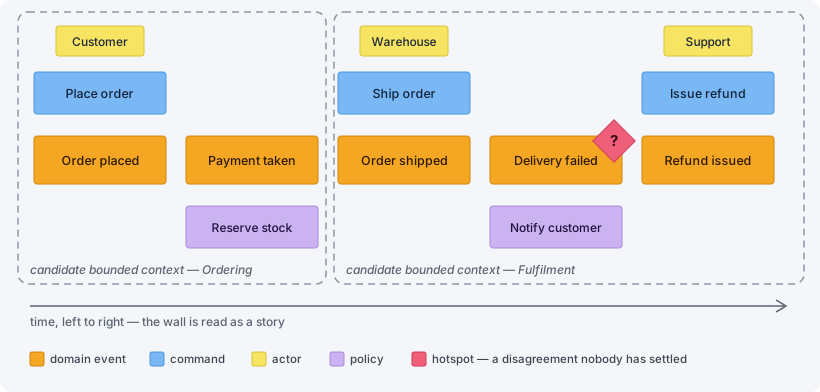
A workshop where domain experts, developers, architects and the product owner build a shared picture of the domain by writing down everything that happens, in orange, in time order, on a wall long enough to make everyone uncomfortable.
Event storming was created by Alberto Brandolini, who described the format in Introducing EventStorming. The official site is eventstorming.com.
How it runs
Section titled “How it runs”- Chaotic exploration. Everyone writes domain events — past tense, business
language,
Order placed,Payment refused— and sticks them up. No discussion yet. The mess is the point: it shows where the disagreement is. - Enforce the timeline. Order them left to right. Duplicates collapse, contradictions surface, and someone says “that never happens” about a note another department wrote.
- Add the causes. Commands that trigger events, the actors who issue them, the policies that react to them, the external systems involved.
- Find the seams. Clusters of events that share a language and change together are candidate boundaries. This is the output the architecture uses.
What it produces
Section titled “What it produces”A wall — photographed, then transcribed into whatever the team keeps under version control. In this platform that transcription usually becomes a C4 model or a set of registered events, so the workshop output stops being a photograph nobody opens again.
Why it is worth the room
Section titled “Why it is worth the room”It is the fastest way to discover that two departments use the same word for two different things. That discovery is worth days of design, and it does not happen in a document review — it happens when both people are looking at the same wall and one of them says “wait, that’s not what we mean by account.”
When to run it
Section titled “When to run it”At the start of a new domain, before a large restructuring, or when a team has been arguing about boundaries for longer than a sprint. Not for a small feature: the setup cost only pays back at scale.
Where it leads
Section titled “Where it leads”The seams found here become bounded contexts, and the events on the wall become the ones registered in the event catalogue. Naming those seams and keeping their language intact all the way into the code is domain-driven design — this workshop is the room its strategic half is usually discovered in.
What the workshop does not produce is an order of work: for that, the same room runs story mapping, which lays the user’s journey out and cuts it into releases. The individual stories then go to three amigos next.
The official source
Section titled “The official source”eventstorming.com is Alberto Brandolini’s own site: the format’s definition, the note colours, the workshop variants (big picture, process modelling, software design) and the book. Read it before facilitating one — this page is a summary of why we run it, not a facilitation guide.