Example mapping
A timeboxed conversation that takes one story and breaks it into four kinds of card. It is the most mechanical of the practices here and the one that most reliably pays for itself on the first attempt.
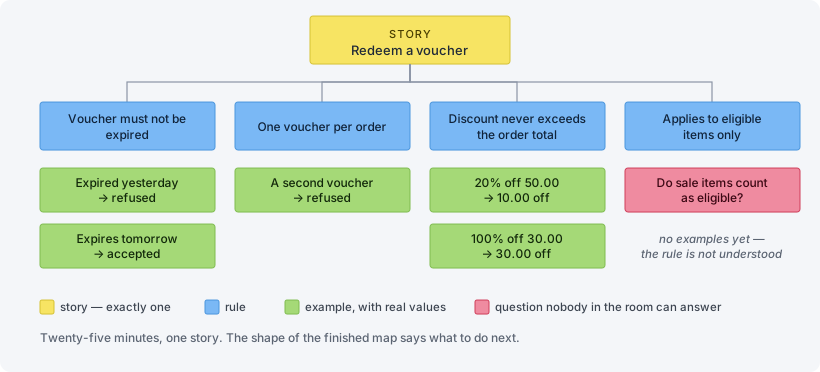
Example mapping was created by Matt Wynne, co-founder of Cucumber, in his 2015 article Introducing Example Mapping. A ready-made template and walkthrough is at draft.io/example/example-mapping.
The four colours
Section titled “The four colours”| Card | Colour | What it holds |
|---|---|---|
| Story | Yellow | The one under discussion. There is exactly one. |
| Rule | Blue | A constraint or acceptance criterion. |
| Example | Green | A concrete case illustrating a rule — real values, not “some input”. |
| Question | Red | Something nobody in the room can answer. |
How it runs
Section titled “How it runs”Twenty-five minutes, no longer. The three amigos plus a domain expert when the domain is where the doubt is.
Write the story. Write the rules under it. Under each rule, write examples until everyone agrees the rule is understood. Whenever someone says “it depends” or “I’d have to check”, that is a red card — write it and move on rather than speculating.
Reading the map
Section titled “Reading the map”The shape of the finished map tells you what to do next, before anyone discusses it:
- Many red cards — the story is not ready. Do not estimate it.
- Many blue cards — the story is too big. Split it along the rules.
- A rule with no green cards — nobody actually understands that rule yet.
- Many green cards under one rule — the rule is more complicated than it looks, and is often two rules.
- Few cards, quick agreement — the story is ready. This is the good outcome and it takes ten minutes.
What it produces
Section titled “What it produces”The green cards are the raw material for BDD scenarios and
then for the acceptance tests. Nothing is retyped: the
examples written on the wall are the ones that become Given / When / Then, and
the ones that decide how the story is cut into
tickets.
The digital artefact
Section titled “The digital artefact”The map leaves the room as a Gherkin feature file, and the translation is almost mechanical — three of the four card colours have a keyword of their own:
| Card | Gherkin | Note |
|---|---|---|
| Story (yellow) | Feature: |
One per file |
| Rule (blue) | Rule: |
A real keyword since Gherkin 6 |
| Example (green) | Example: (or Scenario:) |
Same word, same meaning as the card |
| Question (red) | nothing | An open question is not a specification, so it cannot be written as one |
Feature: Redeem a voucher
  Rule: A voucher must not be expired
    Example: A voucher that expired yesterday is refused      Given a voucher "SPRING20" that expired yesterday      When the customer applies it to a basket of 50.00 CHF      Then the voucher is refused      And the basket total is unchanged
That file is executed by Cucumber exactly as it stands, and it is what a Story ticket description is generated from. The wall and the regression suite become the same artefact — which is the argument set out in full under digital artefacts.
The second formal language
Section titled “The second formal language”Story mapping moves a room out of narrative into the story grammar — one role, one capability, one benefit. Example mapping moves it one rung further, and that rung is where the words stop being a description and start being executable.
| Level | Language | Shape | What it supports |
|---|---|---|---|
| Narrative | Whatever the room speaks | Prose, conversation, a wall | Shared understanding, and nothing a machine can check |
| Story-oriented | The story grammar | As a … I want … so that … |
Ticketing — scheduling, ordering, sizing |
| Scenario-oriented | Gherkin | Given … When … Then … |
Functional acceptance testing — a machine-checked “done” |
The two formal levels are not competing formats and neither replaces the other. They answer different questions and different tools consume them: the story level answers what does someone want, and why, and a tracker reads it; the scenario level answers what exactly happens, with these values, and Cucumber runs it.
The transition is what this session is for. A green card is the moment a sentence
acquires values — “a voucher that expired yesterday”, “a basket of 50.00 CHF” —
and a sentence with values has an outcome someone can observe, which is the
property As a … I want … cannot have no matter how carefully it is worded.
Two rules follow, and both are cheap to apply:
- Do not write scenarios in narrative. “Then the discount is applied correctly” is a narrative sentence wearing Gherkin’s clothes. Correctly is the word that survived the translation, and it carries no value anyone can check.
- Do not write stories in scenario grammar. A ticket whose summary is a
Given / When / Thenhas skipped the level that carries the why, and theso thatclause is the only part that can still answer “should we build this?” six months from now.
Both formal levels are the same ubiquitous language — same nouns, same verbs, two grammars. DDD decides the words; these two levels decide the sentence shapes those words are allowed to appear in.
Not story mapping
Section titled “Not story mapping”Different axis, different session. Story mapping works across the whole journey and decides which stories exist and in what order; this works on one story and decides what it means. The map picks the next card to open; example mapping opens it.
Why the red cards matter most
Section titled “Why the red cards matter most”Every red card is a question that would otherwise have been answered by an assumption, silently, by whoever hit it first — usually a developer at 4pm on the last day of the sprint. Making the question visible costs seconds. Discovering the wrong assumption after release costs a release.
The official source
Section titled “The official source”draft.io/example/example-mapping carries a usable template, the four-colour convention and a walkthrough, and points back at Matt Wynne’s original article. The blue cards are also the first draft of the domain’s invariants and the words on every card are the ubiquitous language being written down, which is why this session is worth having a domain expert in.